Here is something strange about my own bench. For years, I built it with barely any barbell benching at all.
As a sprinter, I could not do much heavy pressing. So most of my upper body work was dumbbells, dips, and push-ups. And yet my bench held up fine, and later shot up fast, off the back of all that non-bench work. That taught me a lesson most gym guys learn way too late.
The bench press is not a chest exercise. It is a team lift, and the smallest player on the team sets your ceiling.
Walk into any gym and watch what stuck lifters do when they want a bigger bench. They bench. Then they bench some more. Then they add a chest fly and call it accessories. They train the bench like it is one muscle, the chest, and they wonder why the number will not move.
But the bench is four muscles working together. Your chest drives the bar off the bottom. Your shoulders carry it through the middle. Your triceps finish the lockout. And your upper back is the solid base you press from. If any one of those is weak, the whole lift is weak. It does not matter how big your chest is if your triceps quit at the top.
Think of it like a chain. A chain does not break at its average link. It breaks at its weakest one. Your bench is exactly the same. So the smart move is not to train your best muscle harder. It is to find your weakest link and build it up.
So let's build the weak links. Here are the five lifts that put the most pounds on a bench, and the exact job each one does.
1. Close-Grip Bench Press (Triceps)
If I could only keep one accessory for the rest of my life, this is it. The close-grip bench is the best triceps builder there is for pressers, and the triceps are the muscle that finishes almost every heavy bench.
You bench with your hands about shoulder width, keep your elbows tucked, and press. It looks like a regular bench with a tighter grip, and that tighter grip throws the work onto your triceps. Because it carries over so directly to the real lift, it builds pressing strength you actually keep. Most lifters who fix a weak lockout fix it here.
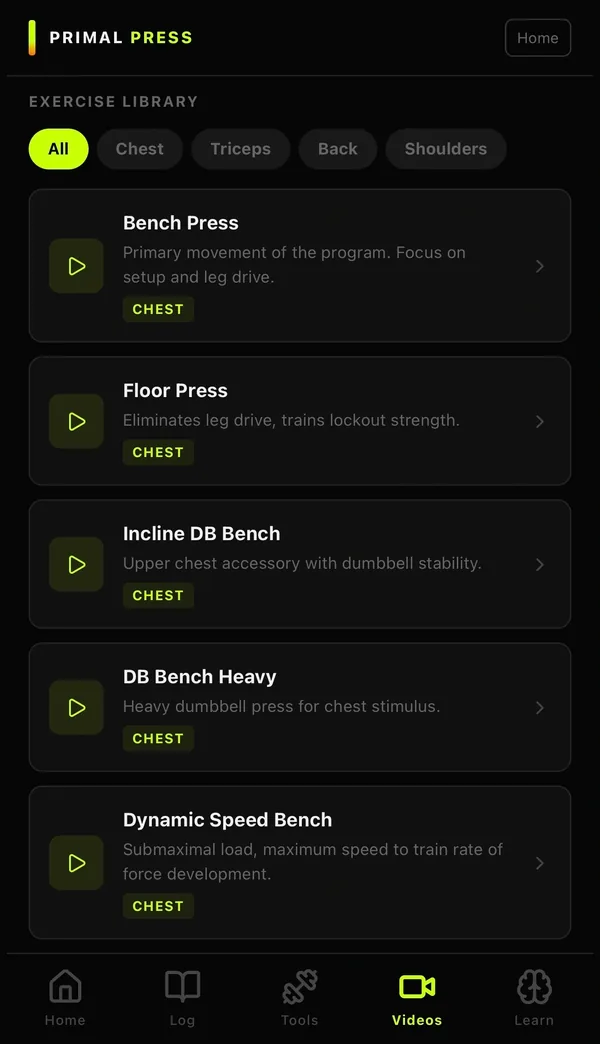
Not sure which of these five your bench actually needs? The app finds your weak link first, then picks the accessories that fix it, so you never waste a set.
Get the Primal Press Protocol2. Weighted Dips (Triceps and Lower Chest)
Dips are the lift that carried my bench through all my sprinting years, and I still swear by them. They hammer the triceps and the lower chest at the same time, in a pressing pattern close to the bench.
Once bodyweight dips get easy, add weight with a belt. Keep your body a little upright to hit more triceps, or lean forward to hit more chest. Strong dips and a strong bench go together almost every time. If you can not do them yet, that is a giant weak spot pointing right at you.
3. Dumbbell Bench Press (Chest)
When your bar dies right off your chest, this is your fix. Dumbbells let your chest stretch deeper at the bottom and work each arm on its own, so a strong side can not cover for a weak one.
They are also far kinder to cranky shoulders than a heavy barbell, which is why I leaned on them so much as an athlete. Flat or a slight incline, pressed with control and a full stretch at the bottom, dumbbell bench builds the chest strength that drives the bar off your body.
4. Heavy Rows (Upper Back)
This is the one that stuck lifters skip the most, and it costs them the most. You do not press off of thin air. You press off of your upper back. It is the shelf your whole bench sits on.
A strong, thick upper back gives you a stable base, keeps your shoulders healthy under all that pressing, and lets you stay tight under heavy weight. Rows, in all their forms, build it. I will be blunt here, because I hinted at this in another article. Lifters who only press and never row end up with beat-up shoulders, usually around year two, and a bench that stalls because the base under it is soft. Row as much as you press. Your shoulders will thank you for the next twenty years.
5. Overhead Press (Shoulders)
The overhead press builds strong, healthy shoulders that carry the bar through the middle of your bench, the exact spot where so many lifts stall.
Pressing a bar or dumbbells straight overhead strengthens the shoulders in a way flat benching never does, and it keeps the joint balanced so it can handle heavy pressing for years. You do not need to go crazy heavy. Solid, controlled overhead work a couple times a week fills in the mid-range weakness that caps a lot of benches.
The 5 Lifts on One Table
Match the lift to the muscle that is holding your bench back. You do not need all five every week. You need the ones that fix your weak link.
| Lift | What it builds | Fixes this weak spot |
|---|---|---|
| Close-grip bench | Triceps | Dead lockout at the top |
| Weighted dips | Triceps + lower chest | Lockout and overall pressing power |
| Dumbbell bench | Chest | Bar dies off the chest |
| Heavy rows | Upper back | Soft base, unhealthy shoulders |
| Overhead press | Shoulders | Stall in the mid-range |
How to Program Your Accessories
Simple rules that keep this from turning into random work.
- Find your weak link first. Where does the bar die? That points to the muscle.
- Pick 2 or 3 of the five. The ones that hit your weak spot, not all of them.
- Train them in the 6 to 12 rep range. Heavy enough to build muscle, clean enough to keep form.
- Row at least as much as you press. Protect the base and your shoulders.
- Add a little weight over time. Accessories need progress too, not the same load forever.
How to Actually Fit These Into Your Week
Accessories are not a fifth and sixth workout. They ride along on the bench days you already have. After your main pressing work, pick one or two of these five and do a few hard sets. That is it. Two or three accessory lifts per session, chosen for your weak link, is plenty. More than that and you are just making a mess and adding fatigue.
Keep them in the 6 to 12 rep range. That is heavy enough to build real muscle but clean enough that your form holds up. And treat them like real lifts, not an afterthought you phone in. Add a little weight or an extra rep over time, the same way you would with your bench. An accessory you never make harder stops building anything.
I am the proof of this myself. For over a decade as a sprinter I could barely barbell bench at all. Most of my upper body work was dumbbells, dips, and push-ups, because heavy barbell pressing was off the table for my sport. And yet my bench held up, then shot from 275 to 325 for reps fast when I came back to it, and later to 365. All those years of dips and dumbbell pressing had quietly built the triceps and chest strength that carried my bench the second I started training it seriously again. The barbell got the credit. The accessories did the work.
The Catch, and How to Skip the Guesswork
Here is the honest part. This list is only useful if you pick the right lifts for you. Load up on triceps work when your real weak link is your chest, and you will grind for months with nothing to show for it. That is the same trap I see over and over.
The whole thing hangs on one question. Which link in your chain is the weak one? Answer that right and these five lifts are a cheat code. Answer it wrong and they are just more tired arms.
That is the exact job the Primal Press Protocol does for you. It finds your weak link, then hands you the accessories that fix it, in the right amounts, in the right weeks. No more picking lifts off a list and hoping. You train the muscle that is actually capping you, and the bar finally moves.
Stop training your best muscle. Go find your worst one and build it.