For about ten years, I was only allowed to bench once a week. And I have the perfect proof of what that does to your bench, because I lived it.
I was a sprinter. In college and then as a pro with a group called ALTIS, I trained next to some of the fastest men alive. Guys like Aries Merritt, Andre De Grasse, and Fred Kerley. On the track, a big heavy upper body is dead weight. So my chest and arm work got cut down to almost nothing. Early in the season we would do a few weeks of dumbbell bench. After that, it was push-ups and bodyweight stuff, and that was it for months.
So here is what happened to my bench during that time. It sat there. For years. I was one of the strongest, most explosive athletes in the building, and my bench barely moved, because I touched it about once a week at best.
Then I stopped sprinting. I started benching like I actually coach people to bench, a few real days a week with a plan. I went from 275 to 325 for 3 reps in a few months. Today I press 365 for 2 at 190 pounds. Same guy. Same body. The thing that changed the most was how often I got under the bar.
If your bench has been stuck and you only train it once a week, I can almost promise that is a big part of your problem.
Let me show you why once a week fails, and then give you the simple plan that fixes it.
The Bench Press Is a Skill, and Skills Fade
Here is the first thing people miss. The bench press is not just a strength test. It is a skill, like a golf swing or a jump shot.
Think about anything you are trying to get good at. If you practiced your golf swing once every seven days, you would be bad at golf forever. Every time you came back, you would feel rusty and have to remember how to do it. You would spend the whole session just getting the feel back, and then you would leave for another week and lose it again.
That is exactly what once-a-week benching does. You spend your one session shaking off rust instead of building on the last one. Your groove never gets sharp because you never get enough reps close enough together. I felt this every single week as a sprinter. My first few bench sets always felt foreign, like I was borrowing someone else's arms.
When you bench two or three times a week, the skill stays warm. Each session starts where the last one left off. The movement gets automatic, and an automatic movement is a strong movement.
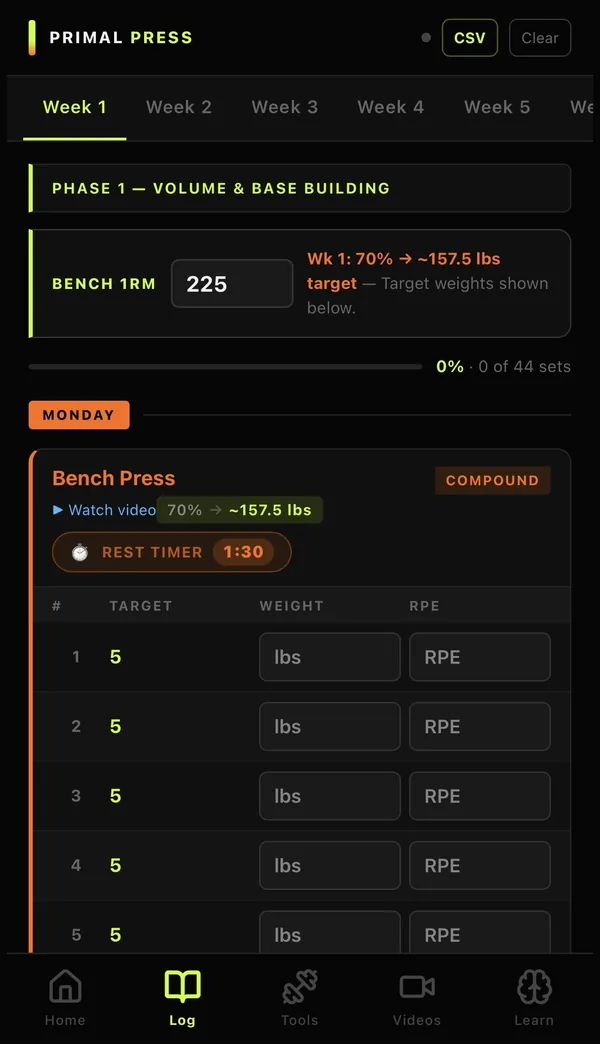
Want the weekly plan built for you, with each day's job, weights, and reps mapped out? That is exactly what the app does.
Get the Primal Press ProtocolYou Can Not Fit Enough Good Work Into One Day
Here is the second problem, and it is just as big.
To get stronger, you need a certain amount of quality work over a week. Call it your dose. Now, you can try to cram your whole weekly dose into one session. But your body can only do so much good work before quality falls apart. Somewhere in that long single session, your reps get slow and sloppy, and now you are just piling fatigue on top of bad reps.
So the once-a-week lifter is stuck between two bad choices. Do too little in that one day and you never get enough dose to grow. Or do too much and half of it is garbage reps that just beat you up. Either way you lose.
Spreading that same dose across two or three days fixes it. Each session is short and sharp. Every rep is quality because you are never grinding through a two-hour marathon. You get more good work in total, and you recover better because no single day wrecks you. This is the whole game.
How Often You Should Actually Bench
For almost everyone who wants a bigger bench, the answer is two to three days a week. Not one. Not seven. Two or three, with each day having a clear job.
The mistake people make when they add days is doing the same heavy workout three times. That does not work. You will burn out fast. The trick is that each day is different. Here is the simple version I use with lifters and used on myself.
| Day | The job | What it looks like |
|---|---|---|
| Day 1 · Heavy | Build top-end strength | Work up to a heavy few reps, leaving one or two in the tank, then backoff sets |
| Day 2 · Speed | Build bar speed and skill | Lighter weight, about half your max, pressed as fast as you can for low reps |
| Day 3 · Volume | Build muscle and groove | Medium weight for more reps, plus close-grip and dumbbell work |
If you can only fit two days, drop the volume day and fold some of it into the other two. One heavy, one speed. That alone beats a single grind day by a mile.
Notice something. Every day still leaves reps in the tank. Every day still presses with a clean, straight bar path. Frequency does not mean more max effort. It means more quality exposure. You are practicing a skill often, not testing a max often. Those are two very different things, and mixing them up is how people hurt themselves trying to bench more.
But Won't I Be Too Sore to Bench That Often?
This is the worry I hear the most, and it comes from a real place. If your one bench day already leaves you sore for three days, benching three times a week sounds insane. But here is the twist. That soreness is coming from cramming everything into one beatdown session. It is the junk reps and the grinding that wreck you, not the benching itself.
When you spread the work out, each day is lighter and cleaner, so no single session digs a deep hole. Most lifters find they are actually less sore on three smart days than on one brutal one. Your body handles a steady, moderate stress far better than one giant shock. This is exactly how sprinters train. We ran hard almost every day, but each session was dialed in so that none of them buried us. The bench works the same way once you stop treating every session like a max attempt.
The rule that keeps it sustainable is the one I keep coming back to. Leave reps in the tank. If every set on every day stops a rep or two short of failure, you get all the practice and all the muscle without the wreckage. Frequency and training to failure do not mix. Frequency and clean, submaximal work are a perfect match.
Then You Organize the Weeks Into Blocks
Frequency is step one. The next layer is what turns a good week into steady progress over months.
Your body responds to a stress, and then it stops responding once that stress becomes normal. So you can not run the same weights and reps forever. You build in waves, called blocks.
Spend a few weeks building up your volume with medium weights. Then spend a few weeks going heavier for lower reps. Then take an easy week to let all that work turn into strength. Then start the wave over, a little stronger than last time. This is the engine most stuck lifters are missing. They do the same thing every week for a year and get the same bench for a year.
How to Add Bench Days Without Frying Yourself
Go from one day to three the smart way.
- Add one day at a time. Go to two days for a few weeks before you try three.
- Give every day a different job. Heavy, speed, volume. Never three grind days.
- Leave reps in the tank on all of them. Frequent practice, not frequent maxing.
- Keep the bar path clean every session. Tucked elbows, straight line, same touch point.
- Take an easy week every fourth week. That is when the strength actually shows up.
The Proof Is My Own Bench
I want to bring this back to my story, because it is the cleanest before and after I can give you.
For a decade, I had world-class training, elite coaches, and an athlete's recovery. And my bench went nowhere, because I touched it once a week. It was not a strength problem. It was not a genetics problem. It was a frequency problem, forced on me by my sport.
The moment I could finally train the bench a few days a week with a real plan, it climbed fast. From 275 to 325 for 3 in a matter of months, and eventually to 365 for 2. Nothing about me got more talented. I just got more quality reps, more often, organized in blocks.
If you are stuck on once a week, you have a huge, easy win sitting right in front of you. But I will be straight with you about the catch. Adding days only works if each day is doing the right job, with the right weights, in the right order. Do it wrong and you just get tired three times a week instead of once.
That is the part I built the Primal Press Protocol to handle. It lays out your week for you. It tells you what to do on your heavy day, your speed day, and your volume day, then organizes those weeks into blocks so you climb instead of spin. It is the plan I wish someone had handed me the day I stopped sprinting.
Add a day this week. Give it a job. Watch what happens.