Almost every stuck lifter I meet believes the same thing. They think they need to train harder. Push more. Add sets. Grind more.
And almost every time, they have it backwards.
You are probably not overtrained. You are under-recovered. And your real strength is sitting right there, hidden under a pile of fatigue.
I learned this in the best classroom there is. Sprinting.
In track, recovery is not a nice extra. It is the whole sport. You can not run fast when you are tired. It is impossible. A tired sprinter is a slow sprinter, full stop. So the best coaches in the world, the ones I trained under at ALTIS, treated rest like part of the training, not a break from it. We would do a small amount of very high quality work, then recover hard, because that is the only way the fast stuff shows up. Push a tired athlete and you do not get a faster one. You get a hurt one.
The bench press is the same, and hardly anyone treats it that way. They think more work always equals more strength. But strength does not happen during training. Training is just the stress. The actual getting stronger happens after, while you rest, eat, and sleep. Skip that part and all your hard work has nowhere to turn into strength.
How Fatigue Hides Your Strength
Here is the simple picture that changes how people train once they see it.
Every hard session does two things to you at once. It builds a tiny bit of strength, and it drops a load of fatigue on top. The strength is real and it lasts. The fatigue is temporary, but while it sits on you, it hides the strength underneath.
So when you train hard week after week with no real rest, the fatigue piles up faster than it drains. Your true strength keeps slowly rising underneath, but you never feel it, because the growing pile of fatigue sits on top of it and makes every weight feel heavy. You think you are getting weaker. You are actually just getting more buried.
Then you take a lighter week, or a few real days off, and the fatigue drains away. The strength that was hiding underneath suddenly shows up, often higher than your old best. Lifters call this a peak and act surprised. It is not magic. You did not get stronger in your week off. You got stronger weeks ago, and you finally let the fatigue clear enough to feel it.
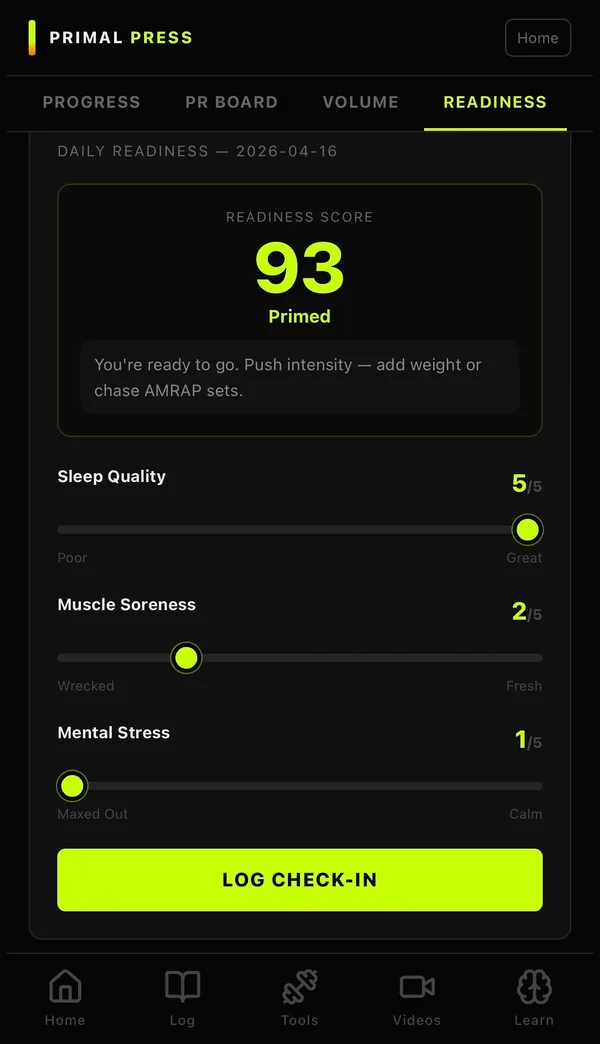
The app watches your fatigue for you and tells you exactly when to push and when to back off, so your strength never stays buried.
Get the Primal Press ProtocolThe Signs You Are Under-Recovered
Fatigue at this level does not announce itself. You do not feel wrecked. You just feel a little flat, a little heavy, for weeks. Here are the signs I teach lifters to watch for.
| The sign | What it really means |
|---|---|
| Weights slowly dropping | Fatigue is winning. Time to back off, not push harder |
| Bar speed feels slow | Your nervous system is tired even if your muscles are not |
| Joints and shoulders ache | You are not recovering between sessions |
| Sleep is short or bad | You are cutting off the exact hours strength is built |
| No drive to train | Often your body asking for rest, not more willpower |
If a few of those sound like you, more training is the last thing you need. You need to let the pile drain.
The Recovery Fixes That Bring Strength Back
None of this is fancy. That is the good news. The basics are boring and they work, and almost nobody actually does them.
Sleep is the big one. It is the number one strength tool you are not using. Sleep is when your muscle repairs and your nervous system resets so it can fire hard again. One extra hour a night does more for a stuck bench than any new program. As a sprinter, sleep was treated like training. It should be for you too.
Take a real deload. Every fourth week or so, cut your weights and volume back for a week. Not skip the gym, just go light and easy. This is the drain valve for that pile of fatigue. Most lifters refuse to do it because a light week feels lazy. Then they wonder why they are always tired and never peaking.
Leave reps in the tank. Grinding every set to failure is the fastest way to bury yourself. Stop a rep or two short on your work sets. You keep almost all the strength gain and dump most of the fatigue. I covered why this works in another article, but it belongs here too, because it is a recovery tool as much as a training one.
Eat and manage your stress. Your body can not repair what you do not feed it, and it can not tell the difference between gym stress and life stress. A brutal month at work lands on the same pile as a brutal month of training. When life gets heavy, your training should get lighter, not harder.
The Recovery Checklist
Do these and your strength stops hiding.
- Add an hour of sleep. The single best strength move most lifters skip.
- Deload every 4th week. Cut weight and volume for one week. Let fatigue drain.
- Leave 1 to 2 reps in the tank. Keep the strength, dump the fatigue.
- Eat enough to repair. You can not build on an empty tank.
- Train lighter when life gets heavy. Stress is stress. Your body counts all of it.
How to Actually Run a Deload
People hear the word deload and picture a week off. That is not it. You still train, you just take your foot off the gas. Keep your bench days, but cut the weight to around 60 percent of your usual and cut your sets roughly in half. Move fast and easy, keep your form sharp, and walk out feeling like you barely worked. That light, almost too-easy week is what lets the fatigue drain while you keep the skill warm. Do not skip the gym for a week. Just go light on purpose.
Sprinting beat this lesson into me. At ALTIS, training next to guys chasing Olympic medals, the hardest thing to accept was that more was not better. You cannot run a true top speed on tired legs, so the whole system was built around recovering hard enough to hit real quality. I watched world-class sprinters take easy days on purpose and get faster for it. When I finally brought that same respect for recovery to my own bench, the same thing happened. I stopped grinding myself flat, I backed off before I thought I needed to, and the numbers climbed. The bench is no different than the 100 meters. Tired is slow, and tired is weak.
This Is Where Most Lifters Need a Coach the Most
Here is the hard truth about fatigue. You are the worst person to judge your own. When you are buried, you feel normal, because buried has been your normal for weeks. That flat, heavy feeling becomes the water you swim in, and you stop noticing it.
That is why the fix is so hard to do alone. Knowing when to push and when to back off is a judgment call, made on a day when your own judgment is clouded by the very fatigue you are trying to measure. Get it wrong and you either bury yourself deeper or back off when you should have pushed.
This is one of the biggest reasons I built the Primal Press Protocol. It tracks your fatigue and your progress and makes that call for you. It tells you when to press hard and when to pull back, so you stop guessing on the exact days you are least able to guess well. It is like having the recovery brain of an elite track coach in your pocket, watching the pile so you do not have to.
You have read the whole map now. How to set up, how to read your sticking point, how often to train, what to build, and how to recover. Five pieces of the same puzzle. The last step is putting them together in the right order, at the right time, for your body. That is the entire job of the app, and it is the job I have spent 16 years doing for lifters by hand.
Stop trying to out-train your fatigue. Recover like it is part of the plan, because it is. Your strength is not gone. It is just waiting for you to get out of its way.