I've been coaching the bench press for 16 years, and I can tell you the exact moment most lifters ruin their progress.
It's the day they start training like someone they're not.
The six-month beginner doing band-resisted board presses because he saw a powerlifter do them. The four-year lifter still running the same add-five-pounds-a-week progression that worked when he was 19. The advanced guy grinding max singles every Monday because that's what "hard work" looks like.
Every one of them is stuck. And every one of them is stuck for the same reason: the right method at the wrong time.
Here's what took me the better part of two decades to fully understand, first as a collegiate sprinter where a hundredth of a second was the difference between All-American and nobody, then through an Exercise Science degree, then through hundreds of stalled benchers who came to me convinced they had a work ethic problem.
Strength is not one skill. It's a sequence of adaptations. Early on, the thing holding you back is precision. Later, it's muscle. Later still, it's your nervous system itself. Each of those limiters responds to completely different training, and each phase has its own signature plateau, its own signature mistake, and its own fix.
This article is the whole map. The three phases, how long each one honestly takes, where lifters get stuck inside each one, why they get stuck there, and what actually breaks it. Not what feels productive. What works.
Phase One: The Technician (Months 0 to 18)
The goal of this phase is not strength. It's precision.
I know that sounds backwards. You want a bigger bench and I'm telling you to chase something else. Stay with me.
In your first 12 to 18 months of serious benching, almost all of your gains are neurological. You're not building much new muscle yet, no matter what the pump tells you. Your nervous system is learning to fire the right muscles, in the right order, at the right time, while staying tight under load. Which means the single highest-return investment you can make in this phase is groove quality. Every rep is a vote for the pattern you'll press with for the rest of your life. Cast good votes.
And this is where I split from most of the internet, so let me be direct about it.
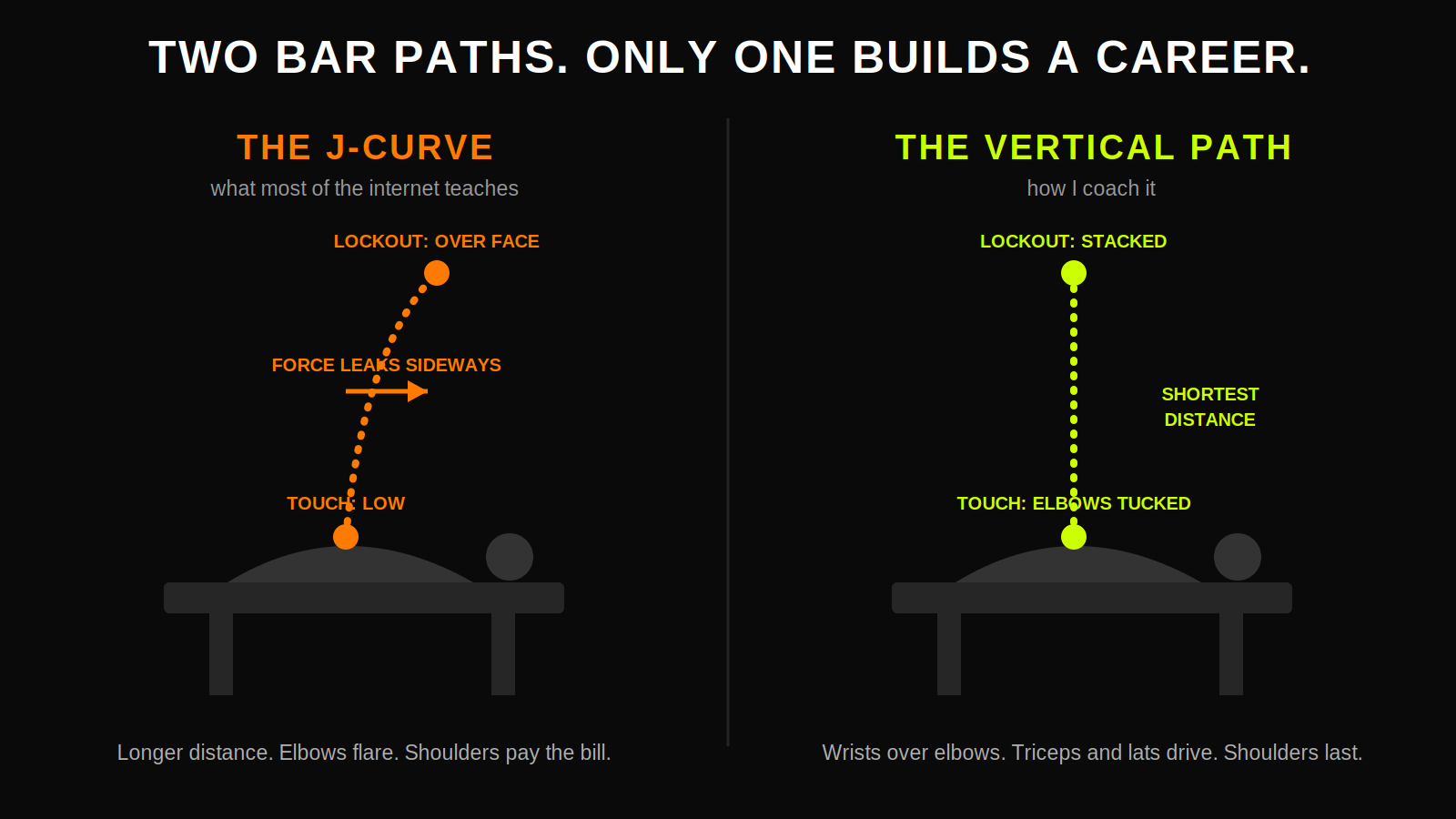
I coach a vertical bar path. Not a J-curve.
The popular cue says touch low on your chest and press back toward your face in a J shape. I teach the opposite: tuck the elbows, stack the wrists directly over them, and drive the bar in a straight line. The shortest distance between two points is a straight line, and every inch of horizontal drift is force leaking sideways instead of pressing the bar up. The straight, tucked press also keeps the load in the triceps and lats longer, which pays off enormously in the later phases, and it keeps the shoulder in a position it can survive for decades. If you spend eighteen months grooving a J-curve, you'll spend another year unlearning it. Build the straight line from day one.
The rest of Phase One looks boring on paper, and that's the point. Bench two to three times a week at weights you can fully control. Pause every rep on the chest. Same touch point, same tempo, same tightness, every single time. Control the lowering phase instead of dropping the bar and bouncing it, because a slow eccentric forces you to actually own the movement. Then build the structure around the press so it doesn't collapse later: rows and face pulls to balance all that pressing, direct work for the small muscles that keep the shoulder centered in its socket, and dips or close-grip pressing to start feeding the triceps that will carry you years from now. A bench press sits on top of an upper back. Lifters who skip the back work find that out the painful way, usually around year two, usually in the front of the shoulder.
Progression in this phase is stupidly simple. Add small amounts of weight, often. That's it. A beginner's nervous system adapts almost session to session, and you don't need anything fancier than showing up and pressing well.
Where Phase One lifters plateau: somewhere between 165 and 225 pounds, usually around month 8 to 14. The bar starts slowing in the same spot. Reps that used to be smooth turn into fights.
The mistake that causes it: maxing. The Phase One lifter feels progress slowing, panics, and starts testing his bench instead of training it. He grinds ugly singles every week to prove the number is still there. And every grinding, elbows-flared, hips-off-the-bench single teaches his nervous system a worse version of the lift. He is literally practicing being weaker.
I watched this play out with a client named Michael, and it changed how I coach forever. He ran the exact same twelve-week program as another client of mine. The other guy added 60 pounds. Michael added zero. Not less. Zero. His logs were perfect, his effort was real, his sleep was fine. Then he sent me training footage, and inside three seconds I had the answer: his form was a disaster, and he had no idea, because bad form doesn't feel bad. Bad form feels normal. It's the only bench you've ever felt. From under the bar you cannot see your own elbows drifting or your bar path wandering. When Michael rebuilt his groove, 40 pounds showed up in about two months. The strength was in him the entire time. It had nowhere to go.
The fix: pull back to around 80 percent of your best, pause every rep, and rebuild the groove for four to six weeks. Film your sets from the side and check the bar against a vertical line. It feels like going backward. It's the fastest way forward, because you're not weak. You're leaking. Seal the leak and the number jumps.
Phase Two: The Builder (Years 1.5 to 4)
Somewhere around the 18-month mark, the free gains end. Adding weight every week stops working no matter how clean your reps are. This is the moment that decides most lifting careers, because the lifters who understand what just changed keep climbing, and the ones who don't spend years stuck at the same numbers blaming their genetics.
Here's what changed: your nervous system has learned the lift. Skill is no longer your limiting factor. Now the limit is hardware. You need more muscle in the pressing chain, and you need a program with an actual engine in it instead of vibes.
The bench press is a triceps, shoulder, upper back, and pec lift, and whichever of those muscles is smallest sets your ceiling. So Phase Two training has two jobs. Job one, grow the pressing muscles with real volume: dumbbell pressing, close-grip work, weighted dips, and more heavy rowing and upper back than you think you need. Job two, organize your training into blocks instead of hoping. Spend several weeks accumulating volume with moderate weights, then shift into a few weeks of heavier, lower-rep work, then back off and let the adaptation land. Then repeat. The body responds to a stimulus, and then it responds to a change in the stimulus. Lifters who send it the same signal 52 weeks a year get the same bench 52 weeks a year.
The timelines here are honest but slow, and I refuse to lie to you about them. Phase Two typically carries a lifter from around a 225 bench to somewhere in the 315 range, and that trip takes two to four years of consistent block training. Anyone selling it faster is selling.
Where Phase Two lifters plateau: the famous walls. 225. 275. The long, demoralizing grind at 295 to 315. It usually shows up as months of hard work where rep PRs at lighter weights keep coming but the max will not budge.
The mistake that causes it: this is the single most common mistake in all of bench pressing, so I'm going to give it room.
The Phase Two lifter takes his bench to failure. Constantly. And it feels so productive that he'll defend it while it buries him.
Here's why it fails. Grinding the last rep before a miss, or missing outright, generates enormous fatigue for almost zero return. The growth stimulus was already banked a few reps earlier. Those final grinders mostly buy you two things: a fatigue debt that bleeds into every session that week, and reps performed with collapsing technique, which trains a sloppier motor pattern on top of the fatigue. Stack that up for a few months and you get a lifter who is chronically tired, pressing with an eroded groove, and calling it a plateau. It's not a plateau. It's a hole, and he digs it deeper every Monday.
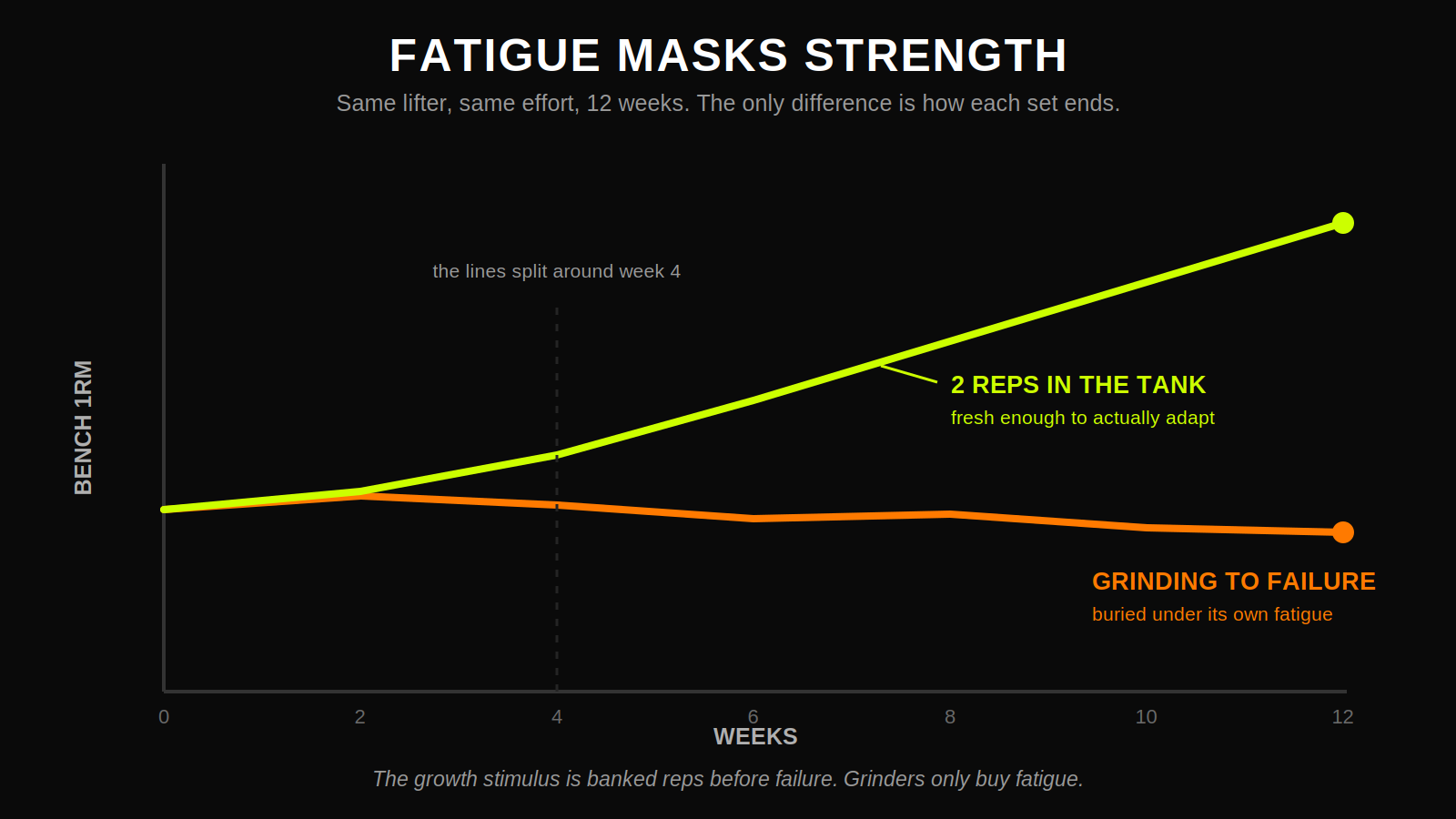
The strength was never gone. It was buried. Which is why the fix works so fast it almost feels like a trick.
The fix: stop testing, start training. Keep your heavy work in the one to three rep range but leave one or two clean reps in the tank on every set. Put your real volume into backoff sets at 65 to 80 percent, moved with speed and a perfect vertical path. Bench two or three times a week, because frequent quality exposures beat rare heroic ones. And attack your specific weak muscle directly. If you fail right off the chest, that's usually a pec and setup problem. If the bar dies halfway, look at your shoulders. If you can't finish the lockout, it's triceps, and with a tucked, vertical bar path the triceps are almost always the guiltiest party. Run that for six to eight weeks and lifters routinely press weights that felt welded to the rack a month earlier. Nothing magical happened. The fatigue drained out and the groove came back.
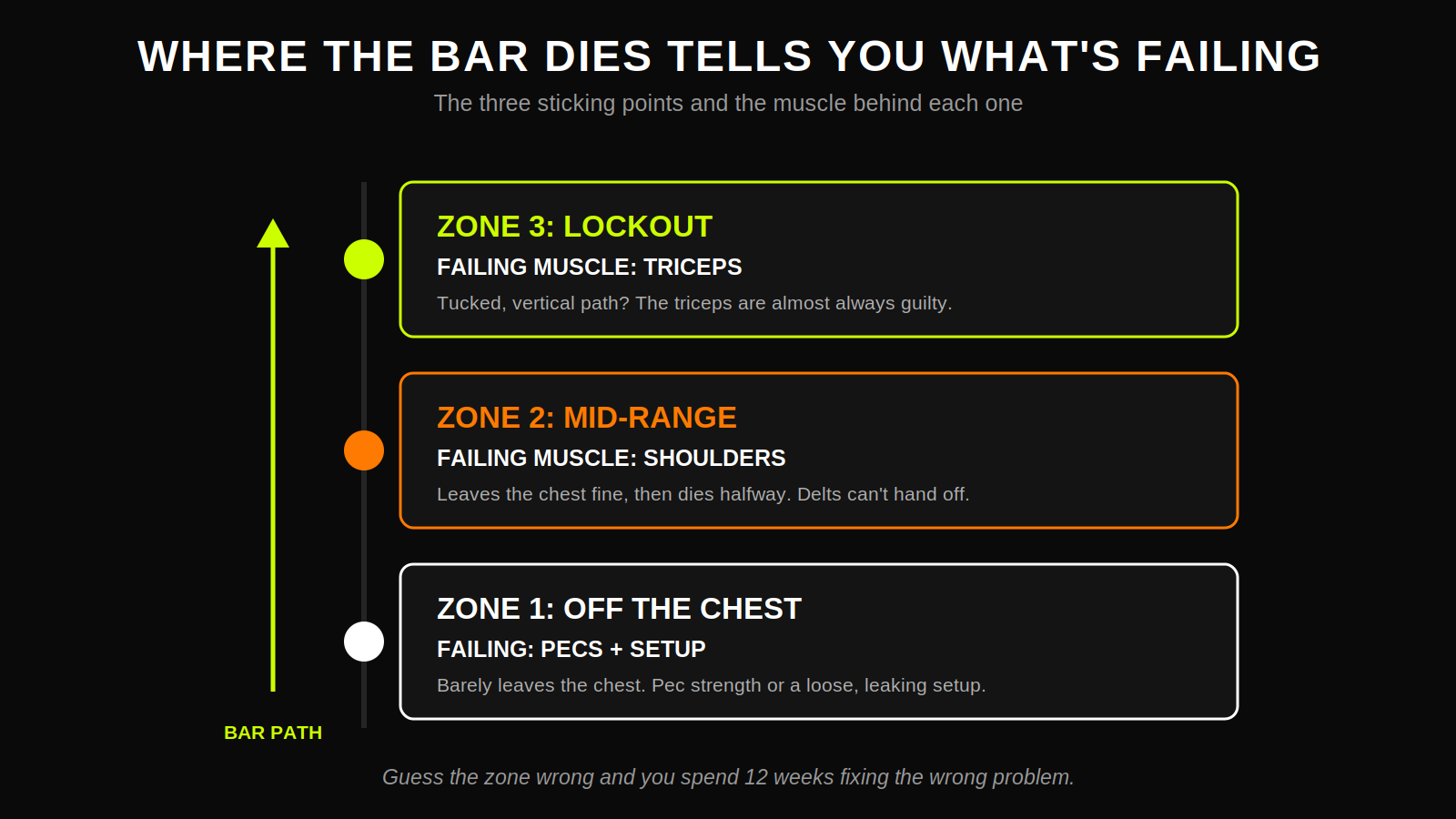
If you can't tell which failure point is yours, that diagnostic question is exactly why I built the Primal Press Protocol. I got tired of watching lifters guess wrong and spend twelve diligent weeks fixing a problem they didn't have.
Phase Three: The Nervous System Years (Year 4 and Beyond)
By this point you have the skill and you have the muscle. You've trained seriously for four or more years, your bench sits somewhere north of one and a half times your body weight, and the old tools have gone quiet. More volume just makes you tired. Another muscle-building block adds beef but not pounds on the bar. This confuses lifters badly, because the things that got them here have stopped working and nobody warned them that this is normal.
Here's the truth about the advanced lifter: his limiting factor is neither skill nor muscle. It's the nervous system's willingness to express force, and the nervous system is a stubborn, adaptive thing. Show it the same stressor for about three weeks and it stops responding. Sports scientists have a name for this, accommodation, and the entire advanced phase is a chess match against it.
The training that wins that chess match stands on a few pillars.
First, you have to strain against genuinely heavy weight regularly, because handling weights above 90 percent is itself a skill, and it fades within weeks when unpracticed. But you cannot take those top weights on the same competition bench press week after week, or accommodation eats you and the groove gets ground down. So you rotate the top-end exercise constantly. A floor press one week. A close-grip press the next. An incline, a press against pin heights, a press with a different grip. Same brutal effort, different vehicle, so the nervous system keeps answering the phone.
Second, you train speed on its own day. Submaximal weights, somewhere in the 50 to 70 percent range, pressed with maximum violence. Force is mass times acceleration, and most stuck lifters have spent their entire careers training only the mass side of that equation. The bar should leave your chest like you're trying to throw it through the ceiling.
Third, bands and chains earn their place here, and only here. Accommodating resistance makes the load grow as you press, which teaches you to accelerate through your sticking point instead of coasting into it and dying there.

And underneath all of it, the oldest rule in strength: find the weakest muscle, hammer it, then find the new one. It never ends. That's the job.
Notice something. The vertical bar path you built back in Phase One is the reason this phase is even available to you. A tucked, straight press is a triceps and lat press, and triceps and lats can be trained hard for decades. The flared J-curve bencher runs out of shoulder long before he runs out of potential.
Progress in Phase Three is measured differently. Five to ten pounds a year on your bench is genuinely good. Some years the win is pressing the same max at a lighter body weight, or with shoulders that don't ache. This is the phase where patience separates the lifers from the quitters.
Where Phase Three lifters plateau: everywhere, constantly, in slow motion. The signature version is the lifter whose training weights decay week over week, whose shoulders hurt all the time, and whose sessions feel harder than the bar speed says they should.
The mistake that causes it: treating intensity like a virtue instead of a dose. The advanced lifter has enough muscle to generate loads his recovery can't cash, and grinding true maxes on the same lift week after week turns training from a stimulus into an erosion.
The fix: rotate and back off like you mean it. Change your top-end exercise every one to three weeks. Hit the heavy single, then leave; don't camp there. Protect the speed day, because it feels too easy to matter, which is exactly why tired lifters skip it and exactly why they stall. And take a genuine light week every fourth week or so. At this level fatigue doesn't announce itself. It just quietly caps your output until you back off and the strength reappears like it was hiding behind a curtain the whole time.
The Whole Map on One Page
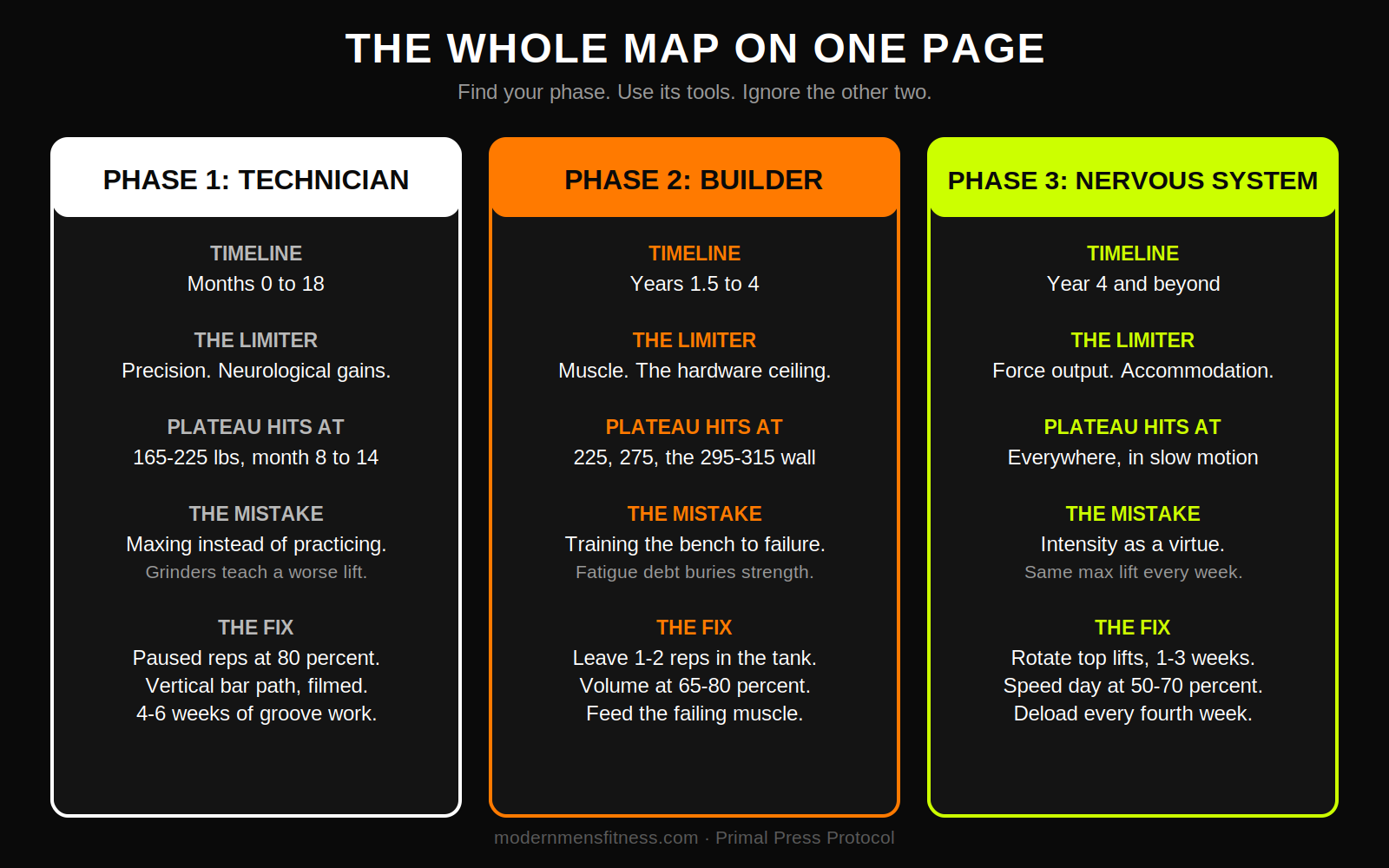
Phase One, roughly the first year and a half: you're a technician. Build the vertical groove, balance the structure, add weight in small honest jumps. You plateau when you start maxing instead of practicing. Fix it with paused, submaximal precision.
Phase Two, roughly years two through four: you're a builder. Grow the pressing muscles, train in organized blocks, keep frequency high. You plateau when you train to failure and drown in your own fatigue. Fix it by leaving reps in the tank, moving fast, and feeding your specific weak muscle.
Phase Three, year four and beyond: you're managing a nervous system. Rotate your heavy lifts, press submaximal weights violently, use bands and chains, back off before you think you need to. You plateau through accommodation. Fix it with variety and restraint.
Three phases. Three different limiting factors. Three different toolboxes. The lifters who get strong for twenty years are the ones who know which phase they're standing in and pick the tools that match.
The lifters who stay stuck are the ones who never figure that out, or worse, never figure out which specific thing inside their phase is capping them. A technique leak, a weak muscle, a program with no engine, or fatigue they've stopped noticing. Guess wrong and you'll spend three diligent months fixing a problem you don't have, exactly like Michael did. I turned my entire process for answering that question into an app, the Primal Press Protocol, because the diagnosis is the part almost nobody can do alone. The training is the easy part once you know what's actually broken.
Find your phase. Find your limiter. Then get under the bar and do the boring, correct thing longer than anyone around you.
That's the whole secret. It just takes about a decade to believe it.